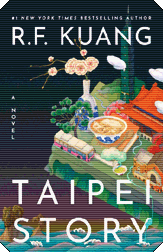
Taipei Story
by R. F. Kuang
Reviewed by Galen Strickland
Posted September 14, 2026
Buy from Bookshop or Amazon. A purchase through our links may earn us a commission.
Taipei Story is Kuang's seventh novel. It is mainstream fiction, not SF or fantasy, and also not a memoir, even though Kuang and her main character do share some experiences. Kuang was born in Guangzhou, China, moving to the US with her parents when she was a child. I'm not sure that applies to the book's first-person narrator, Lily Chen, but her parents had been born in Guangzhou. Lily is a student at Yale, and in the summer following her freshman year she travels to Taiwan for an intensive study of classical Chinese. Kuang did the same, but I'm not sure how many years ago that was. Something else the author and character share is the death of a relative in the midst of their studies in Taipei.
In the afterword, Kuang says she was closer to her gonggong (grandfather) than Lily was to hers. It had been many years since Lily had been to mainland China to see him, and while she still had a passport, her visa for China had expired, so she was not able to attend his funeral. Instead, she wallows in grief and regret in Taipei, missing several days of classes. There had already been other things to depress her before she received word about her gonggong's passing. As for her studies, she regretted not learning more Chinese from her parents, preferring English even at home. She has a hard time understanding certain things about classical Chinese, including chengyu (standard idiomatic expressions), and also struggles finding the right Chinese word or phrase for the English word she knows. On top of that, she has a hard time making friends, or even wanting to make friends, fearing that would distract her from her studies. She is sharing a small apartment with another student from Yale, but they clash due to the close quarters and opposite personality types.
I liked and can recommend this, although I'm not sure how it will be received by others. Lots about Lily's academic efforts, her perception of her progress not always aligning with the reality. After the first couple of weeks she felt she was on the right track, only to receive criticisms from her instructors. She is on her own most of the time, after her falling-out with Anna, and a dreadful night with a boy she had a crush on. Most of her expenses were paid by either Yale or the ICLP, the International Chinese Language Program. She was supposed to use some of that for cultural things, museums and tourist spots, which she does do eventually, but she also watched a lot of films and TV, and attended concerts, which were mostly of European classical composers. It is somewhat a travelogue of Taiwan, along with historical referents, including the tensions between the island and the mainland. Several mentions of Chinese writers, and Chinese and Japanese filmmakers. And of course, lots of food I'm not familiar with, but would like to try.
I'm not a writer myself, not even a good reviewer. I have read some negative reviews of Kuang's previous work, but I did not agree with them. I have liked everything of hers I have read to various degrees, my opinions ranging from "brilliant" to "entertaining." Taipei Story falls somewhere between those extremes, but there is one passage here than fascinated me, and I need to follow up on it to see if I have the same reaction as Lily. One of the concerts she attended was a piano solo of Franz Liszt's Bénédiction de Dieu dans la solitude ("The Blessing of God received in solitude"). I have read and heard others say that the best classical music evokes images in the minds of listeners, although I have not experienced that myself. Lily's description of what comes to her mind while listening to the pianist is one of the most beautiful passages I've ever read. That alone makes this book memorable, even if it turns out I don't have the same reaction if and when I listen to it. In case you get a chance to browse the book in a store or library, it comes at the end of Chapter Five. So, not as good as The Poppy War or Babel, but still enjoyable, still recommended.
Related link:
An Index of my other R. F. Kuang reviews.
We would appreciate your support for this site with your purchases from Amazon.com, Bookshop.org, and ReAnimusPress.