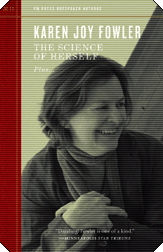
The Science of Herself
by Karen Joy Fowler
Reviewed by Galen Strickland
Posted September 8, 2026
Buy the e-book from Bookshop, or the paperback from Amazon (or e-book). A purchase through our links may earn us a commission.
This is another of the PM Press Outspoken Authors series I received free through Edelweiss several years ago (2021), and several years after it was published (2013). Since it was not an advance review copy I didn't feel compelled to read and review it by any particular date. It contains just two short stories and two essays, plus Fowler's bibliography up to that time, as well as an interview conducted by the series' general editor, Terry Bisson. Both of the essays were original to this book, the stories previously published. None are science fiction or fantasy, although they do skirt around the genres, or science, or are about writing within those genres.
"The Science of Herself" is about Mary Anning, a poor English girl who became well-known within her lifetime, if not fully acknowledged for her accomplishments. I wasn't too far into the essay before I realized I had previously heard of her, although it was from a fictionalized movie, Ammonite (2020), which starred Kate Winslet as Mary. If what Fowler says about the real Mary was true, then Kate was miscast. Supposedly she was not very attractive. She made up for that in what she did, what she learned about fossils, including being the first to find a complete and correctly identified ichthyosaur in 1811, when she was just 12 years old. She became interested because her father was an avid fossil hunter, but he had died the previous year. Mary not only excavated and properly cleaned the fossils, she also wrote about them, and drew accurate depictions of them, although did not speculate as to how the living creatures may have looked or acted. She sold most of her major finds to private collectors or museums, the majority of whom claimed to be the original discoverers. She died at the age of 47, but her reputation has grown since then, with many books and magazine articles about her. She was born and died in Lyme Regis, Dorset, England, and rarely went very far from her home. You can read more about her at the Lyme Regis Museum website. Also original to this book is "The Motherhood Statement," which analyzes how the concept of motherhood and child-rearing has been depicted in SF over the years, as well as how it should be depicted in the future. The discussion also includes real life examples, including the ideas of Freud, B. F. Skinner, and Benjamin Spock.
"The Pelican Bar" is a short story first published in Eclipse 3: New Science Fiction and Fantasy, edited by Jonathan Strahan in 2009. Not SF or fantasy, instead it is a harrowing story of a teen girl who displeases her parents with her wild behavior. As punishment they send her off with two people who take her to another state, possibly another country, where she is held incommunicado at an old motel, along with scores of other delinquent teens. The way they are treated is abhorent, and should be illegal, although Fowler said it was based on similar real life organizations (World Wide Association of Specialty Programs and Schools, including Tranquility Bay in Jamaica, and High Impact in Mexico). "The Further Adventures of the Invisible Man" was originally in 2002's The New Wave Fabulists, and while it may be mostly fabulation, it isn't remotely close to what I think of as New Wave SF. Nathan is a shy, awkward pre-teen boy whose favorite thing is playing The Legend of Zelda, and he desperately wants to get The Adventure of Link, but he can't afford it, and neither can his mother. The title likely refers to his father, whom he has never seen, doesn't even know what his name was. His mother continually tells him stories about what his father may be up to on the planet Zandoor, since he had been abducted by aliens.
The interview is titled "More Exuberant Than is Strictly Tasteful," which refers to a comment she made to the question, What authors do you think have had the most influence on your work? Her reply: "T. H. White, by a mile. [He] is why I have never believed that I had to follow the rules or consider anything resembling a contract with the reader." The interview also gets into her other work, including the novel published just a few months before this book, We Are All Completely Beside Ourselves, which I have but have not read yet. Another is perhaps what she is best known for, the mainstream novel The Jane Austen Book Club, which I also have not read, nor have I seen the movie, and still have never read any of Austen's novels. One of these days perhaps. This is a good book, but not as satisfying as it might have been if it had featured a strong SF or fantasy story, but that ommission is understandable considering how much other mainstream work Fowler has produced.
We would appreciate your support for this site with your purchases from Amazon.com, Bookshop.org, and ReAnimusPress.