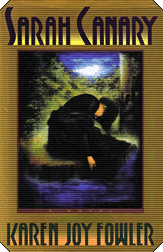
Sarah Canary
by Karen Joy Fowler
Reviewed by Galen Strickland
Posted September 5, 2026
Buy from Bookshop or Amazon. A purchase through our links may earn us a commission.
Sarah Canary is a novel that can be read in different ways by different readers. On the surface it appears to be an historical novel, even if the main characters are fictional. Many real-life people and events are mentioned in short sections in between chapters, setting the scene for the fictional action. Most of it takes place in the provisional territory of Washington in 1873, then toward the end the action moves to San Francisco. The final section speaks of events contemporary to when the book was published (1991), most of which are similar to those reported from more than a hundred years earlier. The first person to encounter the mysterious woman who would later come to be known as Sarah Canary is a Chinese immigrant, Chin Ah Kin, who had worked on railroad crews and in mines. Many readers, if they are not aware of any speculative elements, might miss the significance of the subtle way Chin becomes aware of her.
His first thought is she may be a ghost. He cannot be sure if the sounds she makes are her attempts to speak, and if so, what language it might be. In addition to being fluent in English, Chin was also familiar with other languages, since his mother had worked as a maid for different foreign nationals in Canton when he was a child. If she is not a ghost, she may suffer from some sort of trauma or mental illness, so he takes her to the psychiatric hospital in Steilacoom. He gets a job at the hospital, and also becomes friends with one of the patients, B.J., who seems to be more a trustee, since he is not confined to a cell, and has several work duties. Regardless of his status, it doesn't mean he isn't mentally ill, or of diminished capacity. Another patient, a woman, is the one who comes up with the name Sarah Canary, since the noises Sarah makes reminds her of bird song. Steilacoom's Dr. James Carr is fascinated with Sarah, attempting to communicate with her, as well as trying to analyze her ailment, mentioning to Chin the various types of insanity. Chin and B.J. fear how the doctor will treat her, so they decide to escape the hospital and take her with them.
She runs very fast through the forest ahead of them, and they lose track of her, but do encounter her later. I will not reveal the where and the why, and whom she is with when they find her. I had to read a section a couple of times to verify an abrupt end to that scene, and not that I had missed something the first time. The next time we see Sarah she is not identified as Sarah, but instead, the man she is with is exhibiting her as the "Alaska Wild Woman." Through multiple other events Chin and B.J. try to find her, barely missing her a few times, and one of those times is when Sarah is in the company of another woman, Adelaide Dixon, a suffragist and lecturer on social and sexual mores. Adelaide has the mistaken notion that Sarah is actually Lydia Palmer, a fugitive from justice, wanted for the killing of a man who had seduced her, then abandoned her, instead of following through with his promise to leave his wife. Lydia is fictional, but a similar real-life case is mentioned later.
This was my second reading, and like several other recent re-reads most of it was practically new to me this time. Scenes toward the end were more familiar, including when Sarah disappears, and the aftermath of that, including the death of one of the main characters, who I will not identify. It was when the book was a Nebula finalist in 1992 that I first heard of it, although I am sure it was a few years later when I read it, courtesy of the library in the hardcover pictured above. I now have it in trade paperback. It was also a finalist for a Locus, plus was on the shortlist for the inaugural James Tiptree Jr. Award. More on that later. Mainstream readers not aware of genre awards probably missed the speculative element. In a 2004 interview Fowler was asked about Sarah Canary, which some genre readers interpret to be a first contact story. What would she say to mainstream readers who missed that?
"If I tell them that I believe that Sarah Canary is in fact an extraterrestrial, they usually react with shock… My intention was that the book would read like a science fiction novel to a science fiction reader, and that it would read like a mainstream novel to a mainstream reader, which is the point, that you bring your own perceptions to everything in a very compelling sort of way. (but also) Who Sarah Canary is, is not the point of the book."
Since Sarah never speaks, or at least not in a way the humans around her could understand, this is my interpretation: Sarah, alien or not, is the observer of the weird way humans act. We see the various political and social factions of that time and place, many of which have echoed through the years; how men treat women, how women react to men, how women think of themselves when men are not around. Mix that up with racial tensions; whites against foreign immigrants, whites against indigenous tribes, the white perception of how non-whites think about their women. Sarah can be considered the omniscient observer, but not necessarily our judge. The other characters I've mentioned get the spotlight, Sarah is mainly in the wings watching, thus Sarah is us, the readers. Unfortunately, I am not sure why Sarah disappeared when she did, or where she went. Perhaps back to where she came from, or somewhere else on Earth that interested her, maybe to a different time.
About the Tiptree Award, which has more recently been renamed the Otherwise. I'm surprised Fowler did not recuse herself from nomination since she was the co-founder of the award along with Pat Murphy. She didn't win, but still… The Tiptree was, and the Otherwise is for science fiction or fantasy works that re-examine, expand, or explore our understanding of gender. There are many instances in the book of arrogant men thinking of women as possessions, as accessories for their comfort or release from tension. Even some of the women, Adelaide included, are confused about their own importance, their own worth, and sometimes fall into the traps set by men. Here are just a couple of passages that speak to those issues:
"Men were dangerous and women were not, and when men loved women, women were still not dangerous to them, and when women loved men, then men were the most dangerous of all."
"Someday we will learn that when one woman is wronged, we are all wronged."
Regardless of how you read it, this is a very good book, highly recommended. If anything I have written sounds too confusing, making you think it is not for you, I think that would be the wrong reaction.
Related links:
Fowler's official website
The interview mention above is online at Strange Horizons
We would appreciate your support for this site with your purchases from Amazon.com, Bookshop.org, and ReAnimusPress.