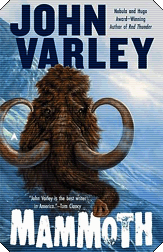
Mammoth
by John Varley
Reviewed by Galen Strickland
Posted September 20, 2026
Buy from Bookshop or Amazon. Both links are for e-books, but Amazon may offer paperbacks through one of their third party sellers. A purchase through our links may earn us a commission.
I read Varley's Mammoth shortly after it was published in 2005, in a hardcover from the Science Fiction Book Club, which I still have. I did not review it then, but just finished a re-read last night. There are parts I like, mostly what I remembered from the first time, but also things I don't, which includes one of the main characters. Howard Christian is sort of a cross between Howard Hughes and Elon Musk. One of the richest men in the world, he is also one of the most eccentric. He was a self-made man, coming up out of poverty, getting the best education he could, which I think was mainly in engineering. He developed computer systems, dabbled in nano-technology and other marvels, with each success providing him with the funds to continue his work. He was also a fan of comic books and movies. He always had envisioned himself as a hero, like Spider-Man, or his favorite X-Men character, Wolverine. He collected vintage cars and planes, as well as toys, although others would think he was crazy for wanting to play with them rather than display them on a shelf, or lock them away in a secure vault.
It is clear Varley was a movie fan, with several other characters the same, including Gaea, as well as Hildy Johnson, Sparky Valentine, and Christopher Bach from three different Eight Worlds books. I'm sure Varley's film fandom preceded his own venture into adapting "Air Raid" into the film and novelization of Millennium (which is referenced in this book, although not by name). Howard Christian, among his other vast holdings, owned movie studios and TV stations, and later married a popular actress. He probably also envisioned creating a true Jurassic Park, but until viable dinosaur DNA was discovered he would settle with cloning a mammoth. A complete mammoth had been found frozen in the far north territory of Nunavut, Canada. Chistian was financing the expedition to extract it. His top right-hand man, Warburton, is sent to verify something considered very unique. The bodies of two humans, a man and woman, are found underneath the mammoth. Odder still, something Warburton saw but didn't report to Christian, and which wasn't there when Warburton returned to the site: the corpse of the man was wearing a watch. There was also a small, metal briefcase underneath the man.
Enter Matthew Wright, a mathematical genius, who had entered MIT at the age of 12, his Masters and Phd earned just a few years later. Christian was convinced that Matt was the one to consult, the best chance to unravel the wonders of time travel. If that was possible, which the Nunavut find seemed to confirm, Christian would be the one to go back in time and obtain dinosaur DNA himself. For the time being though he would take semen extracted from the male mammoth and combine it with an elephant egg for implantation. Wright is hired to study the time travel device, while Susan Morgan is hired to handle several female elephants. She had already been an employee of Christian's for eight years or so, but she never thought of it that way. She worked as an elephant handler for the Ringling Brothers/Barnum & Bailey Circus (A Howard Christian Company). At a warehouse near Santa Monica Susan supervised the elephants, while Matt studied the device inside the briefcase found underneath the mammoth. He knows it will take a long time to understand it, but he was not arrogant enough to think that would be possible. I won't go into details of how the device was activated, but it was completely random and unexpected. The results were that Matt, Susan, the elephants, the still frozen mammoth corpse, and the entire warehouse are thrown back in time.
That was the part I remembered most, but it didn't last as long as I thought. In their search for a water source, Matt and Susan walk several miles, getting lost when they give up and try to go back to the warehouse. There are mammoths around, as well as primitive humans hunting them. While Matt and Susan had been working at the warehouse they occasionally lunched together, and one of the places they had picnicked was the La Brea Tar Pits, which features animatronic mammoths stuck in the pits. In the past they are lost, trying to find their way back to the warehouse, when they see fires in the distance, and hear the roaring of frightened mammoths. The hunters are driving the mammoths toward the tar pits. Matt had brought the time travel device with him, and once again it activates unexpectedly, he has no idea how or why. They are sent back to "present day" (whatever year the book was set, never mentioned), and some of the mammoths come with them. They are right in the middle of the Miracle Mile section of Wilshire Boulevard, adjacent to the tar pits. The mammoth later known as Big Mama battles a city bus, while the younger male (Little Fuzzy) hides near the pits, next to one of the fake mammoths. Howard Christian swoops in for the cleanup, acquiring and claiming the mammoths are his property. Matt Smith quietly escapes, Susan not seeing him for another five years. That is when Susan is working with the mammoths at Christian's Cenozoic Park in Oregon, where Big Mama, Little Fuzzy, and several other mammoth-elephant hybrids perform in a circus atmosphere. The park also includes many animatronic creatures, such as Giant Ground Sloths and sabre-tooth cats. I had remembered nothing about that sequence.
The book begins with an excerpt from a children's book written about Little Fuzzy, who was a hybrid of Columbian and Woolly mammoth. The "first" chapter after that is actually Chapter 5, when Warburton went to Nunavut. That continues numerically up to Chapter 15, then switches to Matt and Susan's adventures in the past in Chapters 2-4. Chapter 1 is the very last in the book, showing how the time travel device ended up underneath the mammoth. I won't say anything about the who, what, and why of those events. As with several other time travel tales there are unexplained paradoxes, along with Matt's ruminations on the concept, which he never understands, yet the device "worked" at least three times. But one has to ask, "Which device?" That's another thing I won't explain. So, some good things in the book, but a lot that had me shaking my head. Thus I can neither recommend it, nor tell you not to bother.
We would appreciate your support for this site with your purchases from Amazon.com, Bookshop.org, and ReAnimusPress.